SIGNATURE · $550 / PERSON
RESTORE US Wilderness
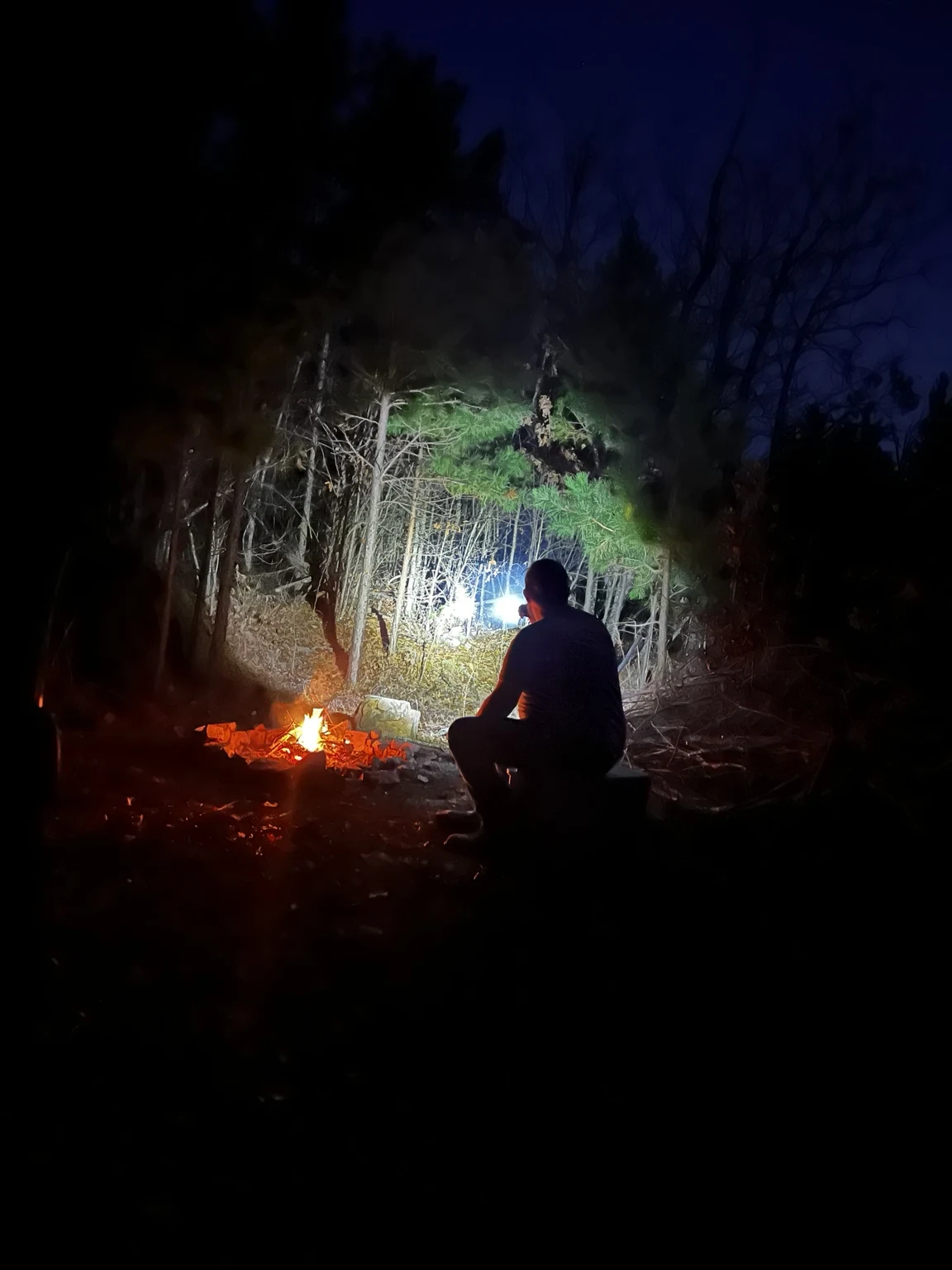
3 days / 2 nights. Bring the complete framework into outdoor living, practical skills, shared responsibilities, and meaningful reflection.
Discover the Experience IRON EMBER LLCUNDERSTAND. RESTORE. STEWARD.
RESTORE US examines the connections between human functioning and everyday life, encouraging practical application, personal responsibility, and stewardship.
Mental, physical, emotional, relational, and spiritual experiences influence one another. The framework helps participants recognize these connections without unnecessary information overload.
Explore each module on its own or experience all nine as one connected program.
Open a module to explore its purpose, topics, and biblical foundations. These working outlines continue to develop.
Understanding how personal experiences shape our beliefs, behaviors, emotional responses, and spiritual understanding.
Experiences, relationships, decisions, and circumstances; what happened versus how we interpreted it; a continually developing story.
Childhood environments, family dynamics, significant events, positive and negative experiences, identity, and self-perception.
Perception, learned behaviors, emotional responses, coping adaptations, and recurring behavioral and relational patterns.
Understanding the influence of experiences, moments of transformation, mistakes, suffering, victories, and lessons learned.
God’s presence during suffering, restoration, sin, or separation; viewing our stories through faith rather than shame.
Recognizing continuing patterns and lessons; deciding what to carry forward; our past influences but does not have to determine our future.
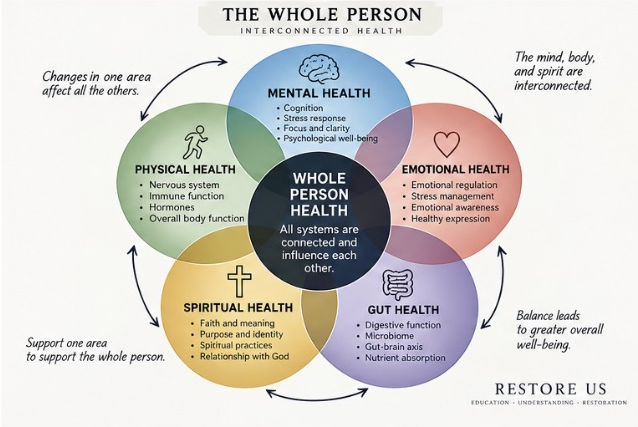
Understanding the interconnected relationships among mental, emotional, physical, spiritual, and gut health.
The body and mind as interconnected systems; relationships among biological, psychological, and spiritual functioning.
Cognition, psychological functioning, stress responses, everyday experiences, and connections with physical and emotional health.
Emotions, emotional regulation, stress responses, and physical reactions.
Nervous system functioning, physiological stress responses, physical conditions, and psychological influences on bodily responses.
The gut-brain axis, communication between digestive and nervous systems, the microbiome, and psychological well-being.
Faith, meaning, beliefs, suffering, spiritual practices, and whole-person health.
Bidirectional influences among all five dimensions; nutrition, hydration, sleep, sunlight, and movement; the RESTORE US interconnected health diagram.
 View educational diagram at full size ↗
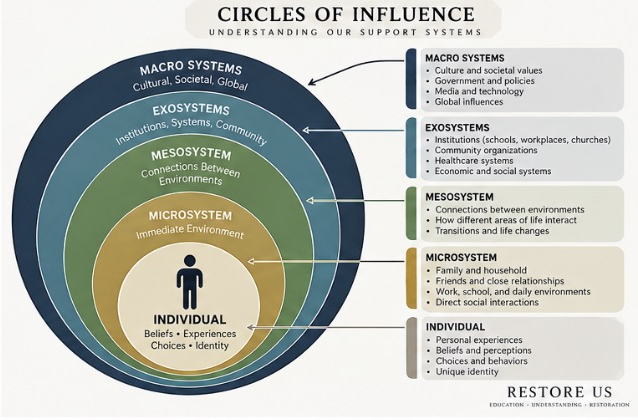
Understanding how relationships, environments, communities, and broader systems influence human development and functioning.
Human connection; supportive and harmful influences; intentional and unintentional influences.
Bronfenbrenner’s Ecological Systems Theory, environmental influences, attachment, relational development, and the original RESTORE US Circles of Influence model.
Family, household, marriage, parenting, friendships, attachment, communication, emotional safety, and relational patterns.
Home, workplaces, schools, daily surroundings, environmental stressors, and supports.
Churches, faith communities, organizations, social groups, belonging, isolation, and giving and receiving support.
Institutions, social systems, culture, media, technology, societal influences, and changing life circumstances.
How we influence one another; boundaries, responsibility, strengthening or harmful relationships, and God’s presence throughout the circles.
 View educational diagram at full size ↗
Understanding how thoughts, beliefs, perceptions, words, and actions influence emotional and psychological functioning.
Information processing, cognition, perception, executive functioning, the prefrontal cortex, automatic thoughts, and learned beliefs.
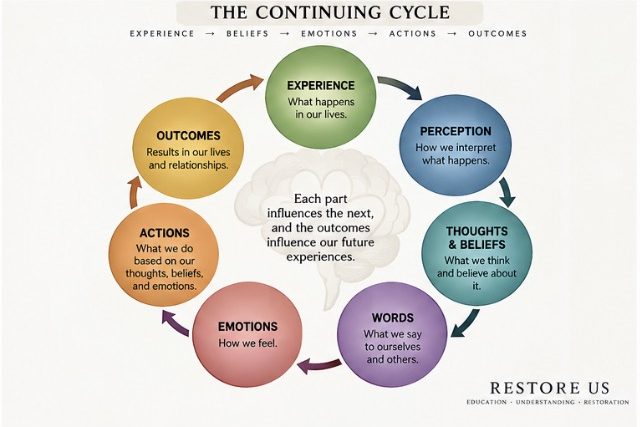
Experience, interpretation, internalized messages, self-talk, cognitive patterns, and their influence on emotions and behavior.
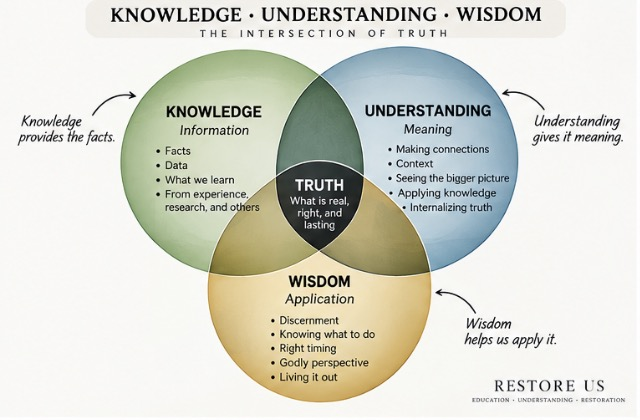
Defining and connecting all three; truth at the intersection; the three-circle RESTORE US model.
Examining beliefs, assumptions, distorted thinking, critical reasoning, spiritual discernment, and biblical truth.
Experience, perception, beliefs, knowledge, understanding, wisdom, discernment, words, emotions, actions, and outcomes that influence future perceptions.
Speaking life or harm; self-talk, identity, messages spoken over children and families, communication, and emotional responses.
Good and rotten fruit; behavioral patterns; identity versus actions; love, boundaries, and the outcomes of beliefs and choices.
Proverbs 2:6 · Proverbs 18:20–21 · Matthew 7:16–20 · Galatians 5:22–23 · Romans 12:2 · 2 Corinthians 10:5
 View educational diagram at full size ↗
 View educational diagram at full size ↗
Understanding how to organize responsibilities around meaningful living, relationships, and God-given priorities.
Order versus perfection, competing demands, busyness, overstimulation, and the illusion of control.
Work as a responsibility rather than an entire identity; family, relationships, and the unique roles we hold in others’ lives.
What matters most; stated versus actual priorities; God, family, relationships, responsibilities, and well-being.
The 24-hour day; the illustrative eight hours each of sleep, work, and life; screen time, calendars, schedules, and ‘I don’t have time.’
Chronic stress, overcommitment, exhaustion, and unsustainable responsibilities.
Saying no, recognizing control, relinquishing unnecessary control, flexibility, rest, and relationships.
Enjoying the present; not waiting until retirement; temporary sacrifices without permanent patterns; trusting God’s provision while exercising responsibility.
Psalm 90:12 · Matthew 6:21 · Matthew 6:25–34 · Luke 10:38–42 · Ecclesiastes 3:1 · Mark 8:36
Understanding how everyday lifestyle practices influence mental, emotional, physical, and spiritual well-being.
Habits, repeated behaviors, consistency versus perfection, and sustainable routines.
Basic nutritional needs, digestion, absorption, whole-person functioning, food, energy, and mental functioning.
Water’s role in bodily functioning and physiological processes; recognizing daily habits.
Circulation, psychological functioning, strength, mobility, daily activity, and sustainable practices.
Neurological functioning, emotional regulation, circadian rhythms, recovery, and consistent sleep practices.
Natural light, outdoor activity, time in nature, psychological well-being, and environmental influences.
Unhealthy lifestyle patterns, substance use, habitual behaviors, and healthier alternatives.
Prayer, Scripture, fellowship, worship, intentional rest, and reflection.
Small changes, consistency over intensity, barriers, and adjusting through changing seasons.
1 Corinthians 6:19–20 · 1 Corinthians 10:31 · Daniel 1 · Galatians 6:9 · 3 John 1:2
Understanding how people become attached to unhealthy patterns, familiar circumstances, and external dependencies, and how they can begin moving toward freedom and personal responsibility.
Unhealthy cycles, familiar patterns, comfort versus growth, and the discomfort of change.
Leaving Egypt; physical freedom versus continued thinking patterns; longing for the familiar, resistance to responsibility, and learning to live differently.
God’s provision, dependence on immediate provision, externally supplied answers, avoiding responsibility, and familiarity as a barrier to growth.
Avoidance, learned patterns, reinforcement, immediate relief, unhealthy coping, and resistance to change.
Alcohol, drugs, technology, social media, work, productivity, compulsive behaviors, and emotional or relational dependencies.
Learned family and relational patterns, repeated behaviors, responsibility, and choosing different responses.
Difficult conversations, indirect confrontation, constructive communication, accountability, trust, and intimacy.
Professional opinions, questions, information, informed consent, personal choice, identity beyond diagnoses, and understanding risks and benefits.
Living in the world without being of it; bondage, idols, unhealthy attachments, and responsibility for freedom.
Exodus 16 · Exodus 32 · Numbers 11 · John 17:14–16 · Galatians 5:1 · 1 Corinthians 6:12 · Romans 12:2
Understanding that healing, identity, forgiveness, resilience, and personal development are ongoing processes grounded in a firm spiritual foundation.
Construction, maintenance, restoration, lifelong growth, and why unfinished does not mean unsuccessful.
Matthew 7:24–27; rock versus sand; storms come to both houses; hearing and practicing Christ’s teachings.
Beliefs, identity, formative experiences, unstable foundations, and a foundation in Jesus Christ.
Our testimony and what we’ve built; past experiences, needed repairs, and a story still developing.
Identity beyond circumstances, mistakes, and harm experienced; self-worth and spiritual identity.
Emotional, psychological, relational, and spiritual restoration; healing is not always immediate or linear.
Meaning, emotional well-being, psychological research, forgiveness versus reconciliation or restored trust, guilt, and shame.
Adversity, adaptation, setbacks, existing strengths, and continuing forward.
The house as a metaphor; damaged areas versus unstable foundations; recognizing mistakes without discarding growth; repairing and strengthening.
Learning, understanding, wisdom, discernment, foundational truths, and continuing restoration.
Matthew 7:24–27 · Philippians 1:6 · 2 Corinthians 5:17 · Romans 12:2 · Ephesians 4:22–24 · 2 Corinthians 3:18
Just because part of the house needs repairing doesn’t mean you bulldoze the whole thing. You go back to the foundation, examine what needs attention, and keep building.
Bringing together the entire RESTORE US framework through personal responsibility, meaning, purpose, spiritual calling, discernment, and faithful action.
Personal responsibility, what has been entrusted to us, and stewardship beyond possessions or finances.
Physical, mental, emotional, and spiritual health; relationships, support systems, time, energy, attention, gifts, abilities, and opportunities.
The search for meaning, psychological functioning, adversity, responsibility, and direction beyond immediate circumstances.
Frankl’s experiences, Man’s Search for Meaning, existential psychotherapy, logotherapy, meaning, responsibility, suffering, and resilience.
Individual gifts, roles within Christ’s body, abilities, experiences, discernment, and spiritual direction. Similar callings need not mean identical approaches.
Paul’s transformation and perseverance; Jonah’s resistance and responsibility; different gifts and service.
Admiration becoming imitation, insecurity, inadequacy, comparing callings, and distraction from responsibility.
Respect, specialized educators, discernment, collaboration, and providing resources rather than reproducing others’ work.
Knowledge, understanding, wisdom, truth, responsibility, and connections to Thoughts.
Recognizing responsibility and control, developing gifts, faithful action despite uncertainty, and serving without waiting for perfection.
Stewarding our story, interconnected health, relationships, beliefs, time, habits, freedom from unhealthy patterns, and continuing growth; living purposefully with what God has entrusted to us.
1 Peter 4:10 · 1 Corinthians 12:4–27 · Romans 12:4–8 · Ephesians 2:10 · Luke 12:48 · Colossians 3:23 · Galatians 6:4–5 · Galatians 1:10 · John 21:20–22
3 days / 2 nights. Bring the complete framework into outdoor living, practical skills, shared responsibilities, and meaningful reflection.
Discover the Experience
One day. Live, interactive education covering all nine modules through teaching, discussion, and everyday-life applications.
Explore Virtual Groups
In person or virtual. Brief, engaging educational highlights introduce Iron Ember and the nine-module framework.
Explore Free PresentationsExplore RESTORE US, attend a free introduction, or discover what awaits in the Oklahoma wilderness.